
Pipe Manufacturing Technology

Overview

Amiantit utilizes advanced composite manufacturing technologies to produce high-performance GRP and GRE piping systems for industrial, infrastructure, and oil & gas applications. Modern production processes ensure consistent laminate quality, corrosion resistance, structural integrity, and long service life for composite piping systems operating under demanding service conditions.

Helical Pipe Production

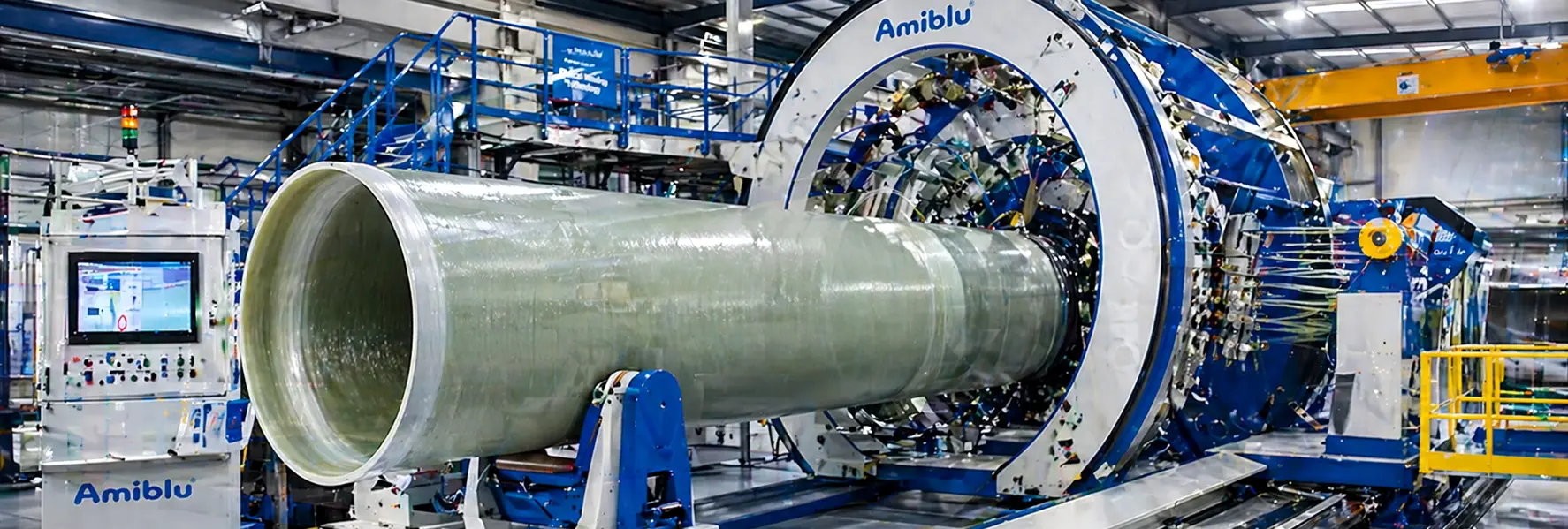
Helical winding technology is widely used for manufacturing large-diameter GRP and GRE  pipes for water transmission, wastewater, and infrastructure applications.

Key features include:

  • Continuous helical winding of glass fibers and resin over rotating mandrels
  • Controlled placement of reinforcement layers for required stiffness and strength
  • Production of large-diameter pipes with uniform laminate structure
  • Capability to manufacture gravity and pressure pipes for infrastructure systems
  • Efficient manufacturing process for long pipe sections

This process allows precise control of pipe stiffness, wall thickness, and mechanical performance.

Continuous Filament Winding Technology

Filament winding technology is used to manufacture high-performance composite pipes and pressure systems for industrial and oil & gas applications.

Key capabilities include:

  • Helical and hoop winding patterns for pressure resistance
  • Controlled fiber orientation to achieve required mechanical properties
  • Automated winding machines ensuring production consistency
  • Engineered laminate structures for pressure, temperature, and chemical resistance
  • Manufacturing of pipes, fittings, and pressure components

This process enables production of high-strength GRP piping systems for demanding service conditions.

Laminate Structure & Material Systems

Composite pipes are manufactured using engineered laminate structures designed to withstand mechanical loads and corrosive environments.

Typical materials include:

  • E-glass or ECR-glass reinforcement
  • Epoxy, polyester, or vinyl ester resin systems
  • Corrosion-resistant internal liners
  • Structural reinforcement layers for pressure resistance
  • UV-resistant external coatings for outdoor installations

These materials provide excellent resistance to corrosion, chemicals, and environmental exposure.

Quality Control & Inspection

Manufacturing processes are supported by strict quality control procedures to ensure product reliability and compliance with project specifications.

Quality assurance includes:

  • Raw material inspection and verification
  • Dimensional and laminate thickness checks
  • Mechanical testing and material verification
  • Visual inspection during production stages

Documentation and traceability for project deliveries

Production Flexibility

Manufacturing systems allow production of composite piping systems across a wide range of sizes and specifications.

Capabilities include:

  • Production of pipes in various pressure classes and stiffness ratings
  • Fabrication of fittings, spools, and special components
  • Manufacturing of pipes for buried, above-ground, and industrial applications
  • Custom production for project-specific requirements

Integration with Engineering

Manufacturing operations are integrated with Amiantit engineering teams to ensure piping systems meet project design specifications.

This coordination supports:

  • project-specific fabrication
  • installation requirements
  • technical documentation
  • engineering support for EPC contractors